
Imagine a business owner learning that a major manufacturing facility will soon be developed in their province. The announcement brings excitement. Local suppliers anticipate new customers, workers look forward to employment opportunities, and nearby establishments begin considering expansion.
But an investment announcement does not automatically put money into circulation. The project must secure financing, complete its facilities, acquire equipment, recruit personnel, and begin operations. Even then, local businesses must qualify as suppliers, negotiate acceptable terms, and deliver what the investor requires.
Between an investment commitment and its economic benefits lies a series of decisions that rarely receive the same attention as the original announcement. This is where governance becomes important.
Investment commitments are encouraging, but what follows matters more
According to the Philippine Statistics Authority, approved foreign investments reached ₱166.03 billion in the third quarter of 2026, representing a 125.3 percent increase from the same period in 2025. Total approved investments from Filipino and foreign investors reached ₱628.19 billion, an increase of 82.7 percent.
These are encouraging figures, particularly amid changing economic conditions and concerns about business competitiveness. They indicate that investors continue to identify opportunities in the Philippines.
However, the PSA makes an important distinction. Approved investments represent commitments or pledges that may be realized in the future. They are not equivalent to capital already deployed into operating businesses. The composition of these commitments also deserves attention.
Electricity, gas, steam, and air conditioning supply projects accounted for ₱397.81 billion, or 63.3 percent of total approved investments during the quarter. Yet the employment expected from all approved projects reached 27,799, slightly lower than the 27,843 projected for the same period in 2025.
This does not mean the investments are less valuable. Energy infrastructure, for example, can support productivity and economic activity far beyond the number of workers directly employed by a project.
It does illustrate why investment value and expected employment should not be treated as interchangeable measures of economic progress. Different industries create different forms of value, and their benefits emerge over different periods.
For policymakers, the challenge includes monitoring which commitments become operational and what economic activity follows.
For corporate boards, the responsibility is different but equally important: ensuring that the investments their companies undertake remain commercially sound, properly financed, and capable of delivering their intended benefits.
The risk of approving a good idea under outdated assumptions
Major investment proposals often begin with an attractive business case. Management presents projected demand, construction costs, expected returns, financing arrangements, and implementation timelines.
The numbers may look reasonable when the project is approved. But what happens when the environment changes?
A facility planned when financing costs were lower may become more expensive to complete. A market initially expected to grow rapidly may experience weaker demand. Changes in technology, regulations, or competition can alter the economics of a project before it becomes operational.
A board should therefore treat the original business case as a set of assumptions that require continuing evaluation.
Suppose a company approves a major warehouse expansion because it expects higher sales and additional distribution customers. Construction begins, but customer orders subsequently weaken. Should management complete the project as originally designed, adjust its capacity, delay certain expenditures, or explore another commercial use?
Each option carries consequences. Continuing may preserve the company’s expansion strategy but increase exposure to underutilized assets. Delaying may protect cash flow while creating contractual costs. Redesigning the facility could improve long-term usefulness but require further investment.
These are difficult decisions, particularly when significant money has already been committed.
Independent directors have an important role in examining whether management’s original assumptions remain valid. Their contribution is not simply to challenge spending. It is to help distinguish investments that deserve continued support from those that require adjustment.
The discipline to reconsider an investment can be just as valuable as the confidence to approve one.
Cash flow reveals what expansion announcements cannot
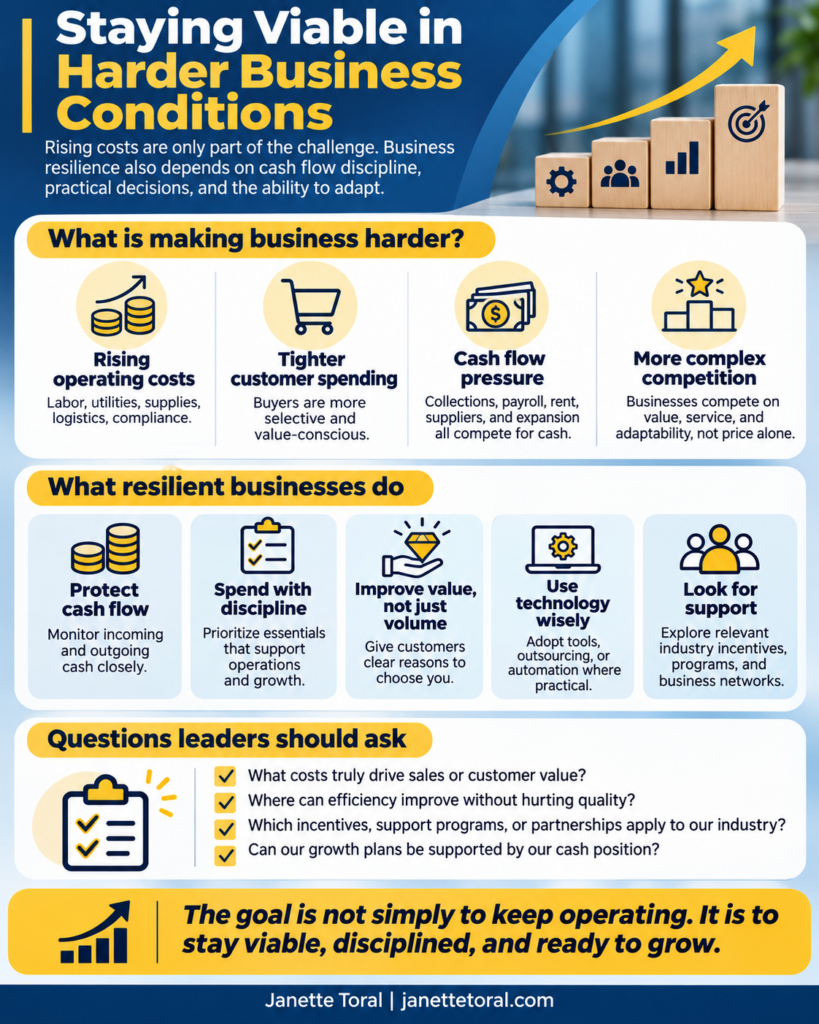
A recent exchange with JC Wong, CEO of Telenta Global Holdings and Executive Director of VAW Sr Leadership Forum, offered a practical perspective on the financial realities behind business expansion. Wong, who has decades of entrepreneurial experience and is pursuing hotel and resort developments, described cash flow as one of his most persistent business challenges.
He discussed experiencing financial obligations, labor and productivity concerns, supplier payments, and other operational pressures while continuing to pursue expansion opportunities. His approach emphasizes financial discipline, exploring alternative sourcing arrangements, using technology where appropriate, and understanding what customers genuinely value before adding expenses.
One particularly relevant observation concerns the difference between increasing sales and maintaining sufficient cash to operate.
A business can have customers, assets, and plans for expansion while still struggling to meet obligations on time. Profitability on paper does not necessarily translate into money available when bills become due. Consider a local packaging supplier awarded a substantial contract by a new manufacturing investor. The supplier may need to purchase materials, increase production, and pay workers weeks before the customer settles its invoice.
The order creates an opportunity, but fulfilling it requires working capital. If payment is delayed, the supplier may struggle financially despite reporting higher sales. Wong’s experience reflects a broader principle relevant to board oversight. Expansion decisions should account for the timing of cash inflows and outflows, not merely the revenue and profitability expected once a project is completed.
Boards should understand whether management has sufficient financial flexibility to handle delays, cost overruns, or slower-than-expected demand. They should also know which conditions would require an intervention before financial pressure threatens the company’s existing operations.
Supplier relationships can strengthen or weaken an investment
An investment project rarely operates independently of other businesses. It relies on contractors, equipment providers, logistics companies, technology partners, maintenance services, and suppliers of materials. Some relationships are temporary, while others become critical to continuing operations.
Procurement decisions therefore influence more than the initial cost of establishing a facility. Selecting the lowest-priced supplier may appear financially attractive, but reliability, production capacity, quality, delivery performance, and business continuity also matter. A supplier unable to sustain operations can create disruptions that cost far more than the initial savings.
Payment practices deserve similar attention. A large corporation may negotiate extended payment terms to manage its own working capital. Yet those terms can transfer considerable financing pressure to smaller suppliers. When suppliers struggle to pay employees, acquire materials, or maintain operations, the purchasing company may eventually experience the consequences through delayed deliveries or reduced service quality.
This does not mean every investor must purchase locally or accept unfavorable commercial terms to support smaller enterprises. Businesses have legitimate obligations to remain competitive and manage costs. However, boards should be attentive to whether procurement practices create avoidable operational risks or weaken relationships that the company depends upon.
Fair and transparent supplier qualification processes, realistic contractual commitments, and appropriate payment arrangements can contribute to supply chain resilience.
For Philippine enterprises hoping to participate in new investment projects, this also highlights the importance of preparation. Having a product or service to offer is only the starting point. Financial capacity, delivery reliability, documentation, and operational readiness influence whether an opportunity becomes a sustainable business relationship.
When incentives influence investment decisions
Another consideration raised by Wong is the importance of understanding government investment incentives. He believes entrepreneurs should actively research programs available through investment promotion agencies, engage with business organizations, and seek clarification about eligibility rather than assume that incentives are inaccessible.
For investors, such programs can influence project feasibility and location decisions. Qualified incentives may improve expected financial returns or help offset certain establishment and operating costs.
From a governance perspective, however, the assessment should go beyond the availability of an incentive. Boards need to understand whether projected benefits are supported by actual eligibility, registration conditions, compliance requirements, and applicable timelines. They should also examine what happens when time-limited benefits expire or when a project falls short of conditions needed to retain them.
An investment that appears commercially viable only because of optimistic assumptions about incentives deserves closer scrutiny.
The same principle applies to other assumptions used in investment proposals. Directors need reliable information about benefits, costs, and risks before authorizing substantial commitments.
Government agencies and corporate boards have different accountabilities here. Public institutions are responsible for administering programs and assessing public-policy outcomes. Corporate boards must ensure that management evaluates incentives accurately and that investment decisions remain aligned with the company’s long-term interests.
What should appear in a board’s investment dashboard?
When management reports that an investment project is progressing, what information would give directors confidence that the company is actually creating value?
Completing construction on schedule and remaining within the approved capital budget are important, but they do not establish commercial success.
A manufacturing facility may be completed within budget and still operate below its intended capacity. A hotel may open on time but achieve occupancy rates that cannot support its financing obligations. A technology investment may be successfully deployed while employees continue using older systems because expected operational improvements have not materialized.
These possibilities suggest the need for performance reporting that connects spending with results.
Depending on the industry and project, directors may need visibility into actual capital expenditures, operating readiness, customer demand, capacity utilization, cash generation, supplier performance, and progress toward expected returns. More importantly, they should know which results are deviating from the business case and what management intends to do about them.
Not every metric requires board-level attention. Directors need information that helps them identify material changes, assess management’s response, and make timely decisions. An investment dashboard becomes useful when it allows the board to recognize emerging problems early enough to act.
There is also value in asking how the company knows whether its investments are creating benefits beyond its immediate operations. Workforce capability, supplier development, customer service, and the reliability of essential infrastructure can influence long-term competitiveness.
These considerations should be connected to the company’s strategy and material risks rather than treated as additional reporting exercises.
From investment confidence to accountable results
The Philippines has good reasons to welcome stronger investment commitments. New projects can expand productive capacity, support infrastructure development, create employment, and open markets for existing enterprises.
But the economic value of an investment unfolds through implementation, operating performance, and the business relationships formed along the way. This requires different forms of accountability.
Investment promotion agencies can improve public understanding of project implementation and realized outcomes. Business associations can help enterprises identify opportunities and prepare to meet supplier requirements. Corporate management must execute approved strategies and respond to changing conditions.
Boards provide oversight by examining whether investments continue to serve the company’s interests, whether material risks are being managed, and whether expected returns remain achievable.
For independent directors, this calls for judgment that goes beyond accepting optimistic projections or questioning every proposal. It requires understanding the business well enough to recognize when assumptions no longer hold and ensuring that difficult issues receive attention before they become more expensive to resolve.
The strongest investment decision is not necessarily the one involving the largest capital commitment. It is one supported by realistic assumptions, sound execution, responsible financial management, and a credible path toward sustained value. Investment pledges can indicate confidence in the country’s future.
What happens after those commitments are made will determine how much of that confidence becomes economic value.

Leave a Reply