
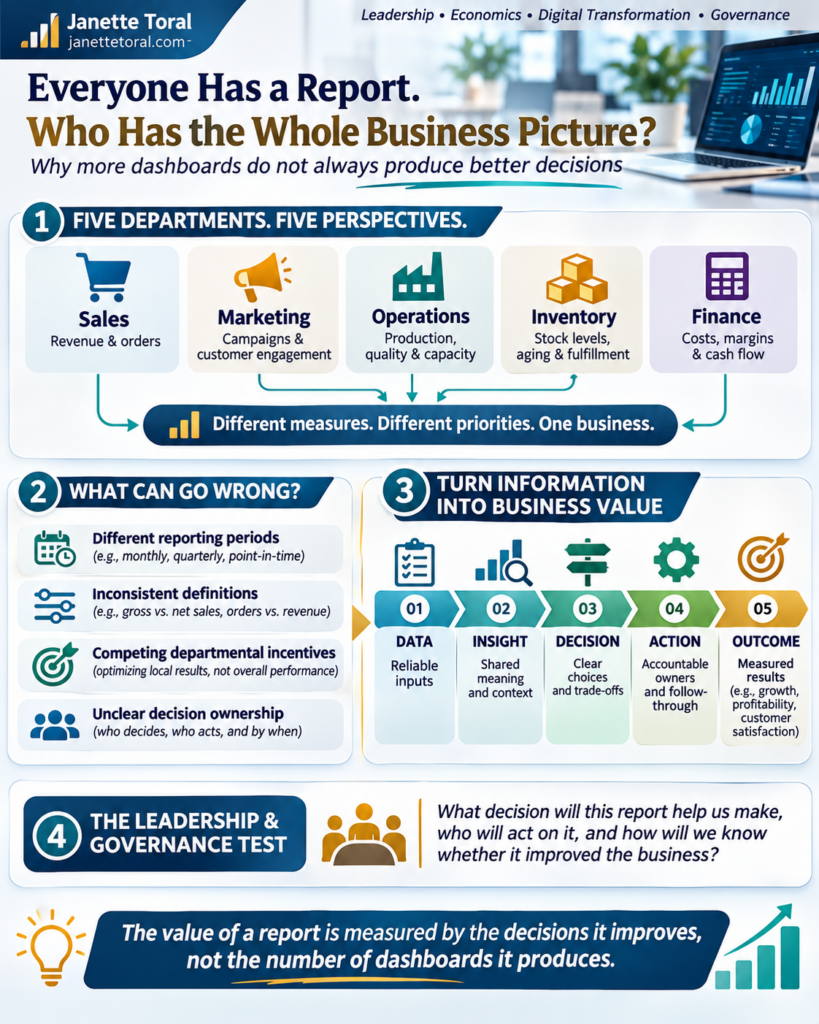
Businesses are producing more dashboards and performance reports than ever. But turning departmental information into a reliable understanding of overall business performance requires something more than numbers.
Imagine a management meeting where every department arrives prepared. Sales presents its revenue and order figures. Marketing discusses campaign performance and customer engagement. Operations reports production efficiency and quality improvements. Inventory provides updates on stock levels and fulfillment, while Finance presents expenses and financial results. Each department has worked on its report and is ready to explain its accomplishments and challenges. Yet when management asks whether the business is in a stronger position than the previous month, the answer may be more complicated than expected.
Sales may have increased while operating costs climbed faster. Production efficiency may have improved even as inventory accumulated. Marketing campaigns may have generated orders, although their contribution to profitability remains uncertain. Customer complaints may point to issues that do not appear in internal quality indicators. These situations illustrate a recurring management challenge: understanding individual department performance does not automatically provide a complete picture of business performance.
In leadership development and business planning engagements, I have come to appreciate how valuable the first structured reporting exercise can be. It encourages teams to examine their activities, organize information, and explain their results. It can also reveal differences in reporting periods, measurement methods, interpretations, and responsibilities that were previously less visible. These discoveries are useful because they create opportunities for management to improve how information is collected, understood, and translated into action.
The greater challenge begins when management must connect the reports and decide what the organization should do next.
The scoreboard and the bigger picture
John C. Maxwell offers two relevant principles in his book, The 17 Indisputable Laws of Teamwork: the Law of the Scoreboard and the Law of the Big Picture. The former emphasizes the importance of knowing where the team stands so adjustments can be made, while the latter directs attention toward the collective goal rather than the importance of individual roles.
Both principles have practical implications for business performance reporting. A department needs its own indicators to understand whether it is meeting its responsibilities. Sales must monitor revenue and customer orders. Operations needs to understand output, quality, and processing time. Finance must examine costs, margins, cash flow, and financial obligations. These measures provide teams with the information necessary to manage their work.
However, the organization’s performance depends on how these activities contribute to common objectives. Increasing sales may be desirable, but the business must also consider whether those sales generate sufficient margins, whether production can fulfill the orders reliably, and whether customers remain satisfied with what they receive. Similarly, improving production efficiency creates greater value when it contributes to dependable deliveries, controlled costs, and customer expectations.
The Law of the Big Picture becomes particularly useful when departments must make decisions involving competing priorities. Each team can have legitimate reasons for recommending a particular course of action. The responsibility of management is to bring those perspectives together and determine which decision best serves the organization.
This is where a shared scoreboard becomes valuable. It should provide a coherent assessment of performance while allowing departments to retain the detailed information needed to manage their respective operations.
When different numbers tell different stories
Economics offers another way to understand this challenge through the concept of information asymmetry. Information is rarely distributed equally among the people involved in a business decision. Employees and managers develop specialized knowledge about the activities they handle, while executives and business owners depend on information provided by different parts of the organization.
A sales manager may understand customer purchasing behavior that is less visible to production. A production supervisor may recognize capacity constraints that sales personnel do not fully appreciate. Finance may identify cost pressures that are difficult to observe from revenue figures alone. All these perspectives are valuable, but decisions become more difficult when the information remains separated.
Management reports are intended to reduce these information gaps. Their effectiveness depends on how clearly the information is defined, explained, and connected.
Consider two departments reporting revenue figures that appear inconsistent. One may be referring to gross marketplace transactions, while another is reporting net sales after adjustments. A marketing team may use attributed campaign sales, while Finance recognizes revenue according to the company’s accounting policies. Both reports can be meaningful within their respective purposes, yet the figures cannot automatically be compared or added together.
The same issue arises when reports cover different periods. A monthly sales figure, a quarterly production summary, and an inventory balance recorded on a particular date represent different measurements. Management needs to understand those differences before reaching conclusions about overall performance.
I encounter a similar challenge when examining economic indicators. Purchasing Managers’ Index surveys, official production statistics, employment data, and trade figures may produce different signals about business conditions. These differences can arise because the indicators measure different activities, populations, or periods. Some provide early indications of changing conditions, while others describe outcomes that have already occurred.
The appropriate response is to investigate what each measure represents and how the indicators relate to one another. A disagreement between indicators can reveal information worth examining rather than automatically establishing that one source is incorrect.
Businesses can apply the same discipline to their internal reporting. When numbers appear inconsistent, management should first examine their sources, definitions, periods, and limitations. This creates a stronger basis for understanding performance and identifying the questions that deserve further investigation.
Why departments can all be right
The challenge extends beyond differences in information. Departments also operate with different responsibilities, incentives, and measures of success.
Economists examine similar issues through principal-agent relationships. In a business, owners and senior executives delegate responsibilities to managers who possess specialized information and exercise discretion over particular activities. The organization’s overall interests and the performance measures assigned to individual departments may occasionally diverge.
Consider a company deciding whether to accept a large customer order. Sales may consider the opportunity attractive because it could increase revenue and strengthen a customer relationship. Production may be concerned about available capacity and the effect on existing commitments. Finance may question whether the proposed price covers the additional costs and working-capital requirements. Each department is evaluating the opportunity through a legitimate professional responsibility.
The difficulty arises when these perspectives become competing positions rather than inputs into a common decision.
This can also explain workplace disagreements where employees strongly defend how things should be done. Someone may insist that an established procedure has worked successfully for years. Another may argue that changing conditions require a different approach. Their conviction can reflect experience and professional responsibility, particularly when product quality, customer commitments, or financial accuracy are involved.
Constructive disagreement becomes valuable when participants explain their evidence, understand the constraints faced by others, and remain open to revising their conclusions. Management must also establish clear decision authority so discussions can lead to resolution.
Incentive alignment is especially important here. If departments are rewarded exclusively for their own indicators, they may unintentionally favor choices that improve local performance while creating additional costs elsewhere. Increasing order volume, for instance, can place pressure on production and fulfillment if demand exceeds available capacity. A production team focused solely on output may overlook the importance of product variety, inventory movement, or customer-specific requirements.
The business benefits when departmental indicators are connected to shared outcomes, supported by agreed responsibilities and a clear understanding of trade-offs.
The hidden economics of producing more reports
There is another cost that businesses should examine: the effort required to prepare, reconcile, and interpret management information.
Transaction cost economics helps explain why organizations need coordination mechanisms, clear responsibilities, and reliable procedures. Within a business, employees spend time requesting information, verifying transactions, resolving inconsistencies, and obtaining approvals. These activities can be necessary for effective control, although poorly designed processes can make them more expensive than they need to be.
For example, a company may have an accounting system that already records supplier payments and supporting transactions. Yet employees may still be required to transfer information manually into several reporting templates. Another person may then need to check whether the same information was entered consistently.
Some additional accounting work is essential because recording a payment differs from recognizing and classifying an expense. Reconciliation, review, and appropriate approvals remain important. The opportunity for improvement lies in understanding which records already exist, what further accounting treatment is required, and which activities can be simplified without weakening controls.
This raises a broader issue for companies investing in digital systems. Technology can accelerate the production of reports, but the economic value of that investment depends partly on whether it reduces unnecessary coordination work and improves the quality or timeliness of decisions.
An organization may generate more information while continuing to struggle with unclear responsibilities, inconsistent definitions, or repeated manual reconciliations. In such cases, the reporting process itself deserves examination.
One useful management question is whether the time spent producing and reviewing a particular report is justified by the decisions it supports. Detailed information may be essential for regulatory compliance, financial accountability, or operational control. Other reports may have accumulated over time without a clear understanding of who uses them or what decisions they influence.
This is where the economic concept of the value of information becomes relevant. Additional information is valuable when it can help improve a decision, reduce uncertainty, or avoid a meaningful cost. Its usefulness depends on the circumstances and choices facing the organization.
A company deciding whether to increase production may benefit most from timely information about confirmed orders, available inventory, production capacity, expected margins, and cash requirements. A business evaluating a new marketing campaign may require different information about customer acquisition, conversions, repeat purchases, and contribution margins.
The important consideration is whether the reporting system produces information that is sufficiently reliable and relevant to the decision at hand.
When AI makes reporting easier, what happens to judgment?
Digital transformation introduces another dimension to this discussion. Businesses now have access to analytics platforms, automated dashboards, and AI tools capable of summarizing large quantities of information. Activities that previously required considerable manual effort can increasingly be completed much faster.
These capabilities create opportunities for smaller businesses to adopt management reporting practices that were once difficult to sustain. Employees can consolidate records, identify trends, create visual presentations, and prepare management summaries with greater efficiency.
However, AI-generated analysis depends on the quality and interpretation of the information supplied. If two reports use different definitions of sales, an automated summary may present their figures together without adequately explaining the difference. If an inventory report uses a later cutoff than a sales report, the resulting analysis may suggest relationships that require further validation.
The polished appearance of a dashboard or the confident language of an AI-generated report can make these limitations less obvious to decision-makers.
For this reason, digital reporting should develop alongside stronger practices for defining metrics, validating information, and reviewing interpretations. Employees need to understand where the numbers originate, what they represent, and which conclusions the available evidence can support.
The most meaningful improvement may come when technology helps people spend less time assembling information and more time examining its implications. Management can then concentrate on understanding significant changes, evaluating alternatives, and following through on agreed decisions.
This also reinforces the importance of communication skills. A useful management review should allow participants to question assumptions, explain unusual results, and discuss differences in interpretation without turning every challenge into a personal disagreement. Trust and accountability are both necessary because an accurate report may contain information that is uncomfortable for the department presenting it.
What the board needs to understand
The same concerns extend to corporate governance. Boards rely on management information to oversee performance, understand material risks, and evaluate strategic decisions. A comprehensive board pack may contain substantial information about financial results, operations, technology, compliance, and market conditions. Its usefulness depends on whether directors can understand how these developments affect the organization’s overall position.
A company may report encouraging revenue growth alongside rising inventory, longer collection periods, or increasing operating costs. Another may show improvements in internal quality indicators while customer complaints require further investigation. Directors need to understand how these developments relate before evaluating management’s conclusions.
The board’s responsibility is to exercise informed oversight, while management remains accountable for preparing reliable information, explaining material differences, and implementing corrective action. Directors should be able to ask how significant figures were established, whether important assumptions have been tested, and what uncertainties remain.
This is particularly relevant when organizations are preparing major investments, expanding operations, entering new markets, or responding to difficult economic conditions. Decisions involving significant resources require a clear understanding of potential benefits, costs, risks, and alternative courses of action.
There is also a useful distinction between monitoring performance and monitoring management’s response to performance. A report may identify an issue requiring attention, but the next review should establish whether the agreed action was completed and whether it produced the intended result.
That is where accountability becomes visible. The organization can examine the connection between information, decisions, implementation, and outcomes.
Making the next management meeting more useful
As businesses prepare their plans for 2027, this may be an appropriate time to revisit how performance reviews are conducted. Instead of beginning every meeting with a sequence of departmental presentations, management can identify the most important decisions that require attention and determine which information is necessary to support them.
Departmental reports would continue to provide essential detail, while an integrated management view would explain the organization’s position, significant developments, unresolved uncertainties, and decisions requiring coordination.
When figures differ, the discussion should establish whether the difference reflects measurement, timing, underlying business conditions, or a genuine discrepancy that needs correction. When departmental recommendations conflict, leaders should examine the available evidence, clarify the trade-offs, and establish who has authority to make the final decision.
The process should also make room for employees to explain what the figures cannot fully capture. Numbers provide a valuable foundation for judgment, while operational experience can reveal constraints, exceptions, and emerging concerns that require further examination.
Ultimately, the purpose of management reporting is to support a better understanding of how the organization is performing and what it should do about the results.
John C. Maxwell’s Law of the Scoreboard reminds us of the importance of knowing where a team stands. His Law of the Big Picture adds the responsibility to connect individual contributions with a shared objective. Economics helps explain why this can be difficult, while digital technology offers tools that can make information more accessible and useful. Governance provides another reason to ensure that the resulting decisions are supported by reliable evidence and clear accountability.
Perhaps the most useful question to ask at the next management meeting is a simple one: What decision will this report help us make, and how will we know whether that decision improved the business?
The answer may reveal more about the organization’s management capability than the number of dashboards it produces.

Leave a Reply