
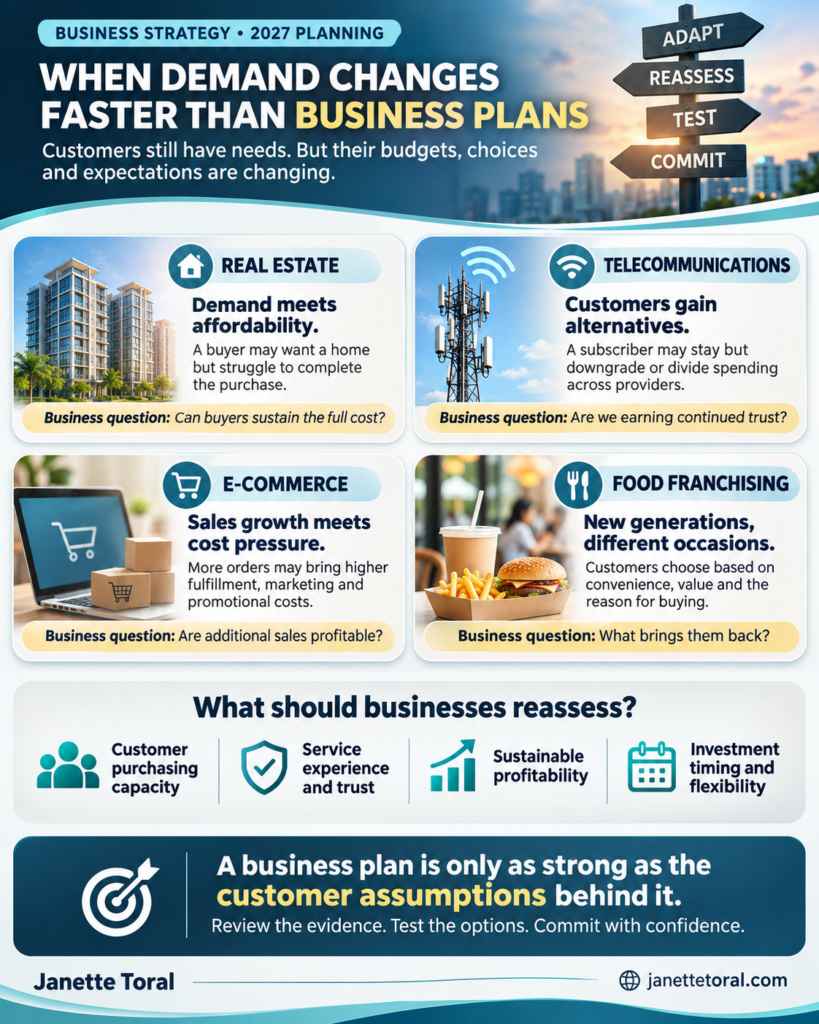
Business plans turn expectations into commitments. Forecast sales justify investments in property, infrastructure, inventory, and people. Once those resources are committed, changing direction carries a cost.
Customers, meanwhile, continue making choices. They reconsider what they can afford, compare alternatives and decide which experiences are worth paying for. Their need for a home, internet access or a convenient meal may remain, while their willingness to accept a particular price or service changes.
As businesses prepare for 2027, I believe these shifts deserve closer examination. Developments in real estate, telecommunications, e-commerce and food reveal different ways in which the assumptions supporting a business plan can become less reliable.
Housing needs a closer look at affordability
Colliers Philippines reported approximately 9,000 condominium purchase cancellations in Metro Manila during the first nine months of 2026. Financing difficulties and the ability to settle outstanding balances as units approached turnover were among the concerns identified. Colliers subsequently explained that its figures came from developers’ inventories. (Source: BNC | BILYONARYO NEWS CHANNEL)
The Association of Real Estate Brokers of the Philippines has called for a clearer breakdown, including which cancellations involved loan disapprovals and which arose from other circumstances. It also cautioned against treating every cancellation as a permanent loss, since properties may subsequently be resold. The figure should therefore be presented as reported cancellations, rather than 9,000 confirmed mortgage rejections. (Source: Philstar QA)
Beyond those transactions lies a more fundamental issue: the relationship between property prices and the purchasing capacity of the households expected to buy.
Having spoken before real estate associations and development companies over the years, I believe the industry needs a more candid discussion about price correction. Where prices have moved beyond what intended buyers can reasonably sustain, longer payment schemes alone may postpone the difficulty until financing becomes necessary.
The Financial Stability Coordination Council’s 2025 Financial Stability Report identifies this concern from another perspective. It notes that high primary-market prices and elevated vacancies increase correction risks, with price-to-rent ratios in several Metro Manila areas indicating overvaluation. Its findings concern particular market conditions, rather than a conclusion that every Philippine property is overpriced. (Source: Bangko Sentral ng Pilipinas)
A correction also deserves a more careful interpretation than a sudden, uniform collapse in prices. I see it as a necessary realignment where selling prices, product design, and financing obligations have become disconnected from customers’ means. Developers face genuine land, construction and borrowing costs. Buyers face equally real limits on income and monthly repayments.
Asking prices, completed selling prices and government valuation benchmarks should be distinguished. When transactions close below advertised prices, those transactions provide evidence worth examining. Describing them simply as sales “below market value” can obscure what the market is actually willing to pay.
Taxation adds another complication. For property transactions subject to capital gains tax, the tax base generally follows the higher of the selling price and the applicable government valuation. The BIR’s July 2026 clarification recognizes zonal and local-assessor values until replaced by approved schedules of market values under valuation reform. A negotiated price reduction may therefore leave the tax base unchanged. The precise treatment depends on the property and transaction involved. (Source: Reyes Tacandong & Co.)
I believe valuation practices should remain responsive to credible transaction evidence as market conditions change. Otherwise, a lower negotiated price may provide less relief than buyers and sellers expect.
The implications extend to the next generation. The Organization for Economic Co-operation and Development has documented declining home ownership among younger cohorts across many member countries, with rising prices and financing constraints among the pressures. This is an international concern, although its causes and severity differ by market. (Source: OECD)
For Gen Z Filipinos to have a realistic path to ownership, future developments must reflect plausible incomes and financing capacity. Smaller initial payments can help buyers enter a transaction. The remaining obligation must also be manageable. Where that relationship has broken down, a reckoning over pricing is necessary.
The customer who stays but spends elsewhere
Telecommunications illustrates a different adjustment. Customers can continue needing a service while becoming less willing to depend on one provider.
Our household had been a long-time PLDT subscriber. We accepted the recommendation to upgrade to Home Fiber, but further outages eventually led us to add Converge and downgrade our PLDT plan.
What disappointed us most was the handling of recurring maintenance concerns. I repeatedly observed neighborhood telecommunications boxes left open and exposed to rain during storms. We raised this with technicians and customer service representatives. More substantial attention followed our warnings that we were considering leaving, and the village connection box, our modem, and handset were eventually replaced.
I cannot determine the technical cause of each interruption. What I can describe is the repeated reporting, the follow-ups, and the loss of confidence that led us to change our arrangement.
Previously, we spent nearly ₱4,000 a month on internet access. We now spend under ₱3,500 combined for two broadband connections. When one becomes slow or unavailable, we have another option. That has reduced the stress associated with an interruption.
PLDT retained our subscription. It lost part of our spending and its position as the connection we trusted to serve us on its own.
This household experience should remain separate from an explanation of PLDT’s financial performance. In its November 12 disclosure, the company reported an 8 percent decline in net income attributable to shareholders for the first nine months of 2026, alongside a 1 percent increase in net service revenues. Higher depreciation weighed on earnings. Those results cannot be attributed to customer switching on the basis of an anecdote. (Source: SEC)
There is also innovation to acknowledge. PLDT’s Fiber Always On offers automatic LTE backup during fiber interruptions and automated repair-ticket creation, subject to availability. I also use GOMO and Smart Magic Data for mobile connectivity. Smart’s no-expiry data offering is itself an example of greater purchasing flexibility from within the PLDT Group.
These developments make the strategic question more demanding: how consistently are new offerings improving the customer’s experience?
From my perspective, rebates are secondary to a lasting resolution. Compensation can offset part of a bill, but repeated follow-ups still consume time and weaken confidence. Preventive maintenance and effective escalation should be considered part of service innovation.
Over the next five years, I expect more households to consider combinations of fixed broadband and mobile connectivity, or two providers where costs and coverage permit. That is a possibility suggested by our experience, rather than a forecast that most homes will maintain multiple subscriptions.
For PLDT and its competitors, retaining a billing relationship is only one measure of success. I would also examine downgrades, repeat faults, repair turnaround, and the reasons customers purchase alternatives. A subscriber can remain active while steadily moving spending and confidence elsewhere.
A growing market still needs viable merchants
E-commerce presents a planning challenge even when demand is expanding.
The 2026 e-Conomy SEA report by Google, Temasek and Bain & Company estimates Philippine e-commerce gross merchandise value at US$28 billion, up 15 percent. This measures transaction value across the market, rather than individual merchants’ earnings.
For a seller considering expansion, the outlook is encouraging. The business case still needs to account for advertising, platform charges, fulfillment, returns, and the cost of serving customers.
Consider an illustrative merchant whose orders increase during a promotion. The campaign could justify its expense if it attracts buyers who return at sustainable margins. A different interpretation is needed if each subsequent purchase requires another subsidy or the promotion mainly replaces sales that would have happened at full price.
The appropriate evaluation extends beyond the campaign period. Early spending to establish a customer base can be reasonable when there is a credible path to recovering that investment.
I would be cautious about expanding inventory or staffing solely because order counts are rising. The stronger basis is evidence that additional sales generate sufficient contribution after direct costs and that the business can finance the resulting working-capital needs.
Young customers buy for different occasions
For food businesses, these questions become local and practical.
A snack can be a quick purchase between classes, an afternoon reward, something shared with colleagues or a take-home gift. Understanding that occasion may be more useful than treating every young customer as part of one uniform market.
A student working within an allowance and an employed Gen Z customer managing a busy day may face different constraints. Even the same person can make different choices depending on the occasion.
Research offers direction, provided its scope remains clear. PwC’s 2025 Voice of the Consumer survey included 501 respondents from the Philippines. Among them, 45 percent reported choosing budget or value brands, while 23 percent identified better value for money as their main reason for switching food brands. These are broader consumer findings, rather than a description of every young diner.
NIQ’s public summary of its Foodie Report 2026 adds another dimension. It reports that 77 percent of Filipino consumers use digital channels to discover places to eat, while 54 percent dine out because they need a quick meal. The summary also highlights clean surroundings and freshly served food among important outlet-selection considerations. These findings likewise cover a broader market than Gen Z alone.
For a franchise operator, I would use this evidence to investigate specific opportunities. Digital visibility can introduce a store to a customer. The purchasing occasion helps determine what the store must deliver once that customer arrives.
A school-area outlet could examine whether an offer fits a short break and a limited budget. An office-area location might test advance ordering or group purchases. These are possibilities to investigate within brand standards, rather than prescriptions for every location.
Established brands should also assess what they can build upon. A familiar product may become relevant to a new occasion without requiring a complete reinvention of the business. A clearer offer, easier purchase process or more consistent execution could be worth testing before committing to a major refurbishment.
Franchisors and franchisees have complementary roles here. Headquarters can examine patterns across the network and determine where experimentation is appropriate. Franchisees can contribute local observations and report purchasing behavior. An arrangement that allows both perspectives to influence decisions would be more useful than expecting individual outlets to adapt without clear authority or support.
The desired result is a commercially sustainable relationship with younger customers. Attention and trial purchases are starting points. The business still needs a reason for people to return.
Make the commitment proportionate to the evidence
These industries operate on different investment cycles. A condominium project, a broadband service and a food promotion cannot be adjusted on the same timetable. Their comparison is useful because it exposes the assumptions that can become hidden behind aggregate sales targets.
The first task is to identify precisely what has changed. “Demand is weak” offers limited direction. Financing difficulties, smaller purchases, service dissatisfaction and customers choosing alternatives suggest different responses.
For relatively reversible decisions, a limited test may be appropriate. A food business could introduce an offer in selected outlets, compare results with similar locations and examine repeat visits, waste and the contribution left after direct costs. Seasonal effects and existing promotions would need to be considered before crediting the new offer with the result.
A major expansion deserves stronger evidence because the exposure is harder to reverse. Phasing the investment, preserving an option to pause, and establishing a review point can provide room to respond as information improves.
Maintaining the existing plan can also be reasonable. A disruption may be temporary, and an abrupt change could weaken service or leave the business unprepared for recovery. Management should be able to explain the basis for continuing, the downside it can absorb, and the developments that would justify reconsideration.
This is where I see a useful role for independent directors. The board’s contribution is to test the assumptions behind significant commitments and examine whether management has considered credible alternatives. Operational decisions remain with management.
An unfavorable outcome alone is insufficient to judge an earlier decision. The information available at the time deserves consideration. Equally, once evidence changes, an organization needs a disciplined way to revisit its position.
A practical basis for confidence
Warnings about difficult conditions can encourage preparation. They become useful when translated into decisions a business can actually make.
For a food operator, that may begin with understanding one important purchasing occasion and testing an improvement. For a developer, it may require reassessing the financial capacity of the intended buyer. For a telecommunications provider, unresolved service problems may deserve investment as urgently as the next product launch.
Confidence comes from having credible choices. A business may be able to improve its offer, remove an obstacle to purchasing, strengthen execution or revise the timing of an investment. The suitable response depends on the evidence and the resources available.
For 2027 planning, I would make the assumptions behind expected sales as visible as the targets themselves. That gives management and boards a firmer basis for deciding where to commit, where to preserve flexibility and which existing strengths deserve continued support.
A plan should help an organization navigate changing conditions. Its usefulness depends on whether the business remains willing to examine the customer reality underneath it.
Janette Toral, GICD, is an independent director and business adviser whose work spans market intelligence, e-commerce, digital transformation and leadership development. The views expressed are her own.

Leave a Reply